
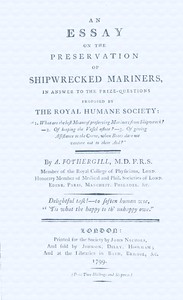
An essay on the preservation of shipwrecked mariners : in answer to the prize-…
Hey book friends! Today I'm pulling something seriously old-school off the shelf, and I bet you've never heard of it before: An essay on the preservation of shipwrecked mariners by Anthony Fothergill. No, it’s not a novel with love triangles and battles. It’s better—it’s a real, live recipe for how people thought about saving each other back when your safest mode of transportation was basically a wooden barrel with a sail stuck to it.
The Story
Okay, here’s the deal. In 1799, the ‘Lloyd's Two Hundred Pound Premium’ was a huge challenge to inventors and thinkers: come up with the best idea to rescue shipwrecked sailors. Most entries were wild failures, but Dr. Fothergill, a British doctor and humanitarian who spent time in America, actually won this thing. This booklet—which reads more like an enthusiastic TED talk from the past—is his winning essay. It lays out three main ideas: how to actually get people off a sinking ship (he wants special rescue boats, like big life rafts strapped to every ship), how to keep them alive once ashore (that means be sheltered, fired, and fed), and how to smuggle letters to families from survivors. It is so practical and so oddly charming because he genuinely thinks—like, deeply believes—we can automate or social-solve disaster. No gods, no myths, just: What if every ship carried small, affordable lifeboats? And what if every coastal town trained a dedicated rescue squad? Fothergill invented this system and called it ‘a welfare fund for the sons of the storm’. He realized before anyone else: planning is free; letting people die costs too much.
Why You Should Read It
Honestly? Because it’s a revelation that tweaks the way you see current events. When you read a report about a modern shipwreck run by 2020s radar set, half the process is immediately recognizable in this guy’s 225-year-old plan. It's human honesty. He hadn't invented radio or helicopters, so he imagined physical sets of dinghies that buoyed themselves. His approach to the art of staying calm and practical in true crisis mode is timeless. The essay is written without any fluff—just clear, scolding yet plea-maker sentences aimed at an public meeting. He changes gears and begs for officials to pay for floating chests stocked with biscuits. I finished it feeling cheered. Someone, in a harsh wooden age, looked a a death count not by beating his chest but by sitting down and saying: We can rearrange some paperwork and some planks, and it fixes all this. The unshakeable part later came true: many of his proposals later influenced the US Life-Saving Service, precursor to the Coast Guard. For history-nut bonafides, your nerd credit will triple.
Final Verdict
Maybe we expect books from genius inventors or super-rich quack explorers—and this is decidedly low-key. It's amazing page-turner for exactly these people: You who can genuinely get interested in human ingenuity when lives are on the line. If curio or altruism or any taste of 1799 London caught your ear at a history museum, do not snooze. This little thing feels ahead of Christopher Columbus of idea-smuggling humanity's most underrated design chore.
The copyright for this book has expired, making it public property. You can copy, modify, and distribute it freely.
Richard Williams
6 months agoAfter a thorough walkthrough of the table of contents, the insights into future trends are particularly thought-provoking. Simple, effective, and authoritative – what else could you ask for?




Kimberly Hernandez
5 months agoI took detailed notes while reading through the chapters and the step-by-step breakdown of the methodology is extremely helpful for students. Thanks for making such a high-quality version available.