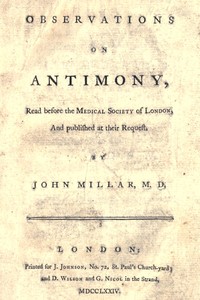
Observations on antimony by John Millar
So, what is this book actually about? Let's be clear: it's not a novel. Published in 1788, it's a short scientific treatise. John Millar, a Scottish physician, sits down to write everything he knows and has observed about the element antimony. In his time, antimony compounds were a huge deal in medicine. They were used as powerful emetics (to make you vomit) and purgatives, but they were also notoriously toxic if you got the dose wrong.
The Story
There isn't a plot in the traditional sense. Instead, the 'story' is Millar's intellectual journey. He systematically goes through the history of antimony, from its murky alchemical past—where it was wrapped up in symbolism and mystery—to its practical medical uses. He describes its different forms, how it's prepared, and most importantly, the effects it has on the human body based on his own clinical experience. The central thread is his effort to bring order and reason to a substance that was both revered and feared. He's trying to turn an art into a science, arguing for careful observation over tradition.
Why You Should Read It
You should read it for the raw, unfiltered voice of early science. Millar isn't writing a dry textbook; he's arguing, questioning, and sharing his genuine fascination (and caution). You feel his frustration with outdated practices and his determination to get it right. It's a powerful reminder of how hard-won our basic medical knowledge is. Reading his careful notes on dosages and symptoms, you gain a huge appreciation for the doctors who had to figure things out through trial and (sometimes tragic) error. It makes modern medicine feel like a miracle.
Final Verdict
This isn't for everyone. If you need a fast-paced narrative, look elsewhere. But if you're curious about the history of science or medicine, this is a hidden gem. It's perfect for history buffs who enjoy primary sources, for science lovers interested in the messy beginnings of chemistry, or for anyone who likes seeing how a single, focused mind tackles a complex problem. Think of it as a fascinating conversation with an 18th-century doctor over a cup of tea, where he passionately explains the most important metal you've never heard of.
This is a copyright-free edition. Use this text in your own projects freely.
Richard Perez
6 months agoThis digital copy caught my eye due to its reputation, the breakdown of complex theories into digestible segments is masterfully done. A trustworthy resource that I'll keep in my digital library.
Joseph Jones
5 months agoSolid information without the usual fluff.
George Martin
1 year agoThis work demonstrates a clear mastery of contemporary theories.
Mary Lopez
3 months agoI decided to give this a try based on a colleague's recommendation, the bibliography and references suggest a high level of research and authority. I'll be recommending this to my students and colleagues alike.

Christopher Miller
5 months agoBefore I started my latest project, I read this and the level of detail in the second half of the book is truly impressive. This adds significant depth to my understanding of the field.